
P: +86-18866913099
E: sales01@latelas.com
E: sales01@latelas.com
NO 888 Maltsea Industrial Park, Mine Town, Lanling County, Linyi City, Shandong Province, China
Views: 0 Author: Site Editor Publish Time: 2026-11-11 Origin: Site


Incorrect sizing in continuous manufacturing carries huge financial risks. If you under-size your equipment, you face catastrophic pressure drops. This instantly halts production lines and ruins product batches. On the other hand, over-sizing leads to excessive energy waste. It also causes premature equipment wear from constant short-cycling. Sizing for continuous production requires a highly specific framework. A continuous 100% duty cycle differs completely from intermittent, shop-level demands. You cannot use the same simple estimations. We must apply a strict engineering-led approach to establish true baseline demand. You need to account for hidden environmental variables before installation. We will also evaluate modern drive technologies to match your exact consumption profile. This guide breaks down the precise steps required. You will learn how to audit your pneumatic tools accurately. We will show you how to calculate system pressure drops. Ultimately, you will discover how to select the perfect machinery to keep your facility running flawlessly.
Base your sizing on actual Cubic Feet per Minute (CFM) consumption, not Horsepower (HP).
Add a strict 15–20% capacity buffer for leaks and immediate expansion—exceeding this buffer can compromise efficiency.
Match your demand profile to the right drive technology: flat demand suits fixed-speed units, while fluctuating continuous demand requires a Variable Frequency Drive (VFD).
Factor in pressure drops from piping, air treatment equipment, and environmental conditions (altitude/temperature) before finalizing specifications.
Most sizing mistakes stem from a basic misunderstanding of pressure versus flow. In pneumatic engineering, we measure two completely different properties. PSI represents pressure or force. CFM represents flow or volume. Continuous manufacturing relies heavily on sustained CFM. If your system cannot deliver enough volume, pressure drops across the entire plant. You must prioritize volume over static pressure.
You cannot guess your baseline demand. You must audit your facility. We recommend physically inspecting every piece of pneumatic machinery. Check the manufacturer tags on your equipment. Record the required CFM for each device. To find your peak demand, sum the requirements of all simultaneously operating equipment.
List all continuous-use pneumatic tools.
Record the specific CFM requirement for each tool.
Identify which machines operate at the exact same time during peak shifts.
Add these numbers together to establish your absolute peak CFM.
A true industrial air compressor must meet this peak continuous requirement easily. It cannot rely on recovery time. If your peak demand hits 500 CFM, your equipment must deliver 500 CFM continuously without resting. If the machine needs to pause and rebuild pressure, production will stall.
Once you calculate your peak baseline demand, you must add a safety buffer. We advise adding a strict 15-20% buffer to your final number. This extra capacity accounts for inevitable system leaks. It also accommodates near-term facility expansions. Minor leaks develop over time in any large piping network. This buffer ensures these leaks do not starve your end-use tools.
However, you must respect the limits of this rule. We strongly warn against buying two sizes up just in case. Artificial over-sizing forces the machine to operate inefficiently. It will constantly load and unload. This short-cycling wastes massive amounts of electricity. It also wears out internal bearings prematurely. Stick rigidly to the 15-20% margin.
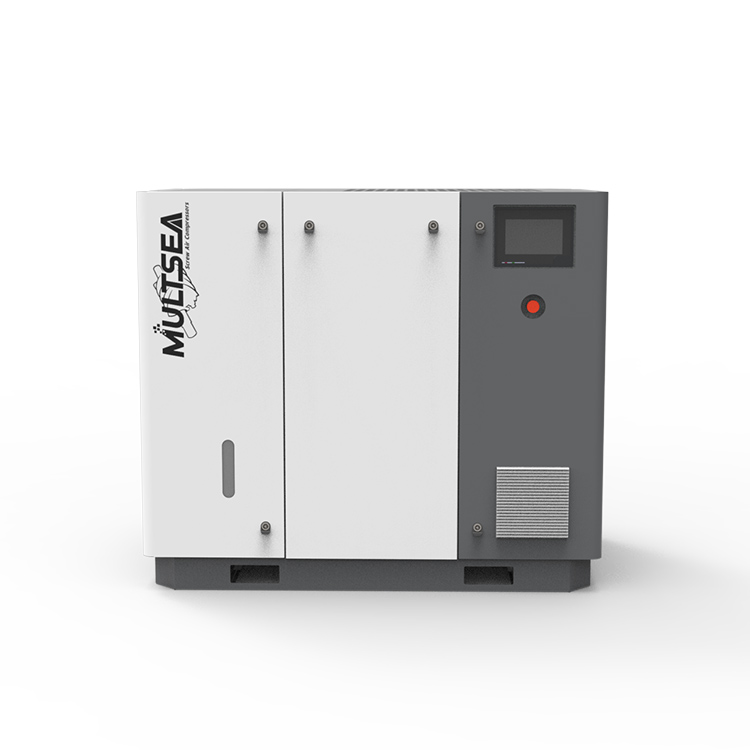
Matching your demand profile to the correct motor technology determines your long-term success. Not all continuous operations consume air at the exact same rate. Some factories use the same amount of air 24 hours a day. Others run continuous baseline operations but experience heavy spikes during specific shifts. You must choose your drive technology accordingly.
Fixed-speed units operate on a simple principle. When they turn on, they spin at full speed. They deliver 100% of their rated capacity continuously. If your plant runs a completely flat, unchanging 24/7 pneumatic load, this technology works perfectly. The motor runs at its maximum efficiency point constantly.
Under these specific conditions, a fixed-speed electric screw air compressor is highly efficient. It also carries a much lower initial capital expenditure. You avoid paying for advanced electronics you do not need. Maintenance remains straightforward because the electrical components are relatively simple. If your demand curve is a flat line, fixed-speed is your best engineering choice.
Many facilities do not enjoy perfectly flat demand curves. You might run a heavy day shift and a lighter night shift. You might use intermittent heavy machinery alongside continuous baseline operations. In these scenarios, a fixed-speed unit will waste energy by blowing off excess pressure. You need a smarter solution.
A VFD screw air compressor solves this exact problem. VFDs adjust the actual motor speed to match fluctuating demand perfectly. If the factory only needs 60% of total capacity, the motor slows down to deliver exactly 60%. It eliminates wasteful unloaded running. Evidence clearly shows that VFDs can reduce energy consumption by up to 35% in facilities with variable demand. This massive efficiency gain easily validates the higher initial purchase price.
Many buyers read the specification sheet and assume the job is done. This is a critical engineering mistake. What the machine produces at its discharge valve is not what reaches your factory floor. Every component between the discharge valve and the end-use tool acts as a restriction. We call this the component penalty.
Industrial applications require clean, dry air. Moisture and particulates ruin pneumatic cylinders and spoil product finishes. To achieve this, you must install air treatment equipment. You will likely use in-line refrigerated or desiccant dryers. You will also install particulate filters and oil-water separators. Each of these components forces the air through a restrictive medium.
This restriction causes inherent pressure drops. A standard particulate filter might consume 3 PSI. A refrigerated dryer might consume another 5 PSI. If you fail to account for these drops, your final tool will lack the force needed to operate.
Typical Component Pressure Drops
System Component | Average Pressure Drop (PSI) | Impact on System |
|---|---|---|
Refrigerated Air Dryer | 3 to 5 PSI | Reduces moisture, slight flow restriction |
Desiccant Air Dryer | 5 to 7 PSI | Eliminates dew point, higher restriction |
Particulate In-line Filter | 2 to 4 PSI | Traps dust, increases drop as it clogs |
Coalescing Oil Filter | 3 to 6 PSI | Removes oil aerosols, heavy restriction |
Your piping infrastructure further restricts airflow. The diameter of the pipe dictates air velocity. Narrow pipes create immense friction against the pipe walls. The total length of the pipe run also amplifies this friction. Furthermore, every elbow, tee, and valve disrupts smooth laminar flow. They create turbulent air pockets that drain kinetic energy from the system.
You must calculate these piping losses alongside your air treatment deductions. To solve this, instruct your engineering team to size the equipment for a higher starting PSI. If your machine needs 90 PSI at the tool, and you calculate 15 PSI of downstream losses, you must configure your equipment to discharge at 105 PSI. This sizing adjustment guarantees the end-use machine receives its exact required operating pressure.
The physical environment surrounding your installation dramatically impacts performance. Air is not a constant substance. Its density changes based on where you install the machinery. You must adapt your sizing calculations to your specific geographical location and facility layout.
Air becomes thinner at higher elevations. Less dense air means fewer oxygen molecules per cubic foot. The machine must work much harder to compress the same mass of air. If you install equipment in Denver, it will not perform the same as it would in Miami. We use a standard derating rule of thumb in the industry. Expect roughly a 1% loss in volumetric efficiency for every 1,000 feet of elevation above sea level. You must upsize your CFM requirement to offset this altitude penalty.
Ambient temperature also plays a critical role. Hot air expands. It holds less mass per volume compared to cold air. High ambient temperatures reduce intake air density, lowering overall output efficiency. Additionally, high heat reduces the cooling efficiency of the machine itself. Industrial units generate massive amounts of internal heat during compression. If the surrounding room is already hot, the internal coolers will struggle to dissipate thermal energy. This can trigger automatic high-temperature shutdowns.
Proper installation prevents overheating and mechanical failure. When you install a large stationary screw air compressor, you cannot shove it into a tight, unventilated closet. These units require substantial footprints. You must leave at least three feet of clearance around all sides. This allows maintenance technicians to access panels safely. It also provides space for proper intake ventilation. If you place the unit in an enclosed mechanical room, you must install dedicated exhaust fans. You must actively duct the exhaust heat out of the building. Otherwise, the machine will ingest its own hot exhaust, leading to rapid failure.
When you move past the initial specification sheet, you must evaluate vendors based on strict performance metrics. Do not simply look at the sticker price. A cheaper unit upfront often consumes vastly more electricity over a decade of continuous operation. You need an evaluation framework that prioritizes energy efficiency, reliability, and support.
You cannot compare two machines based on Horsepower alone. You must evaluate units based on their Specific Power. In our industry, we measure Specific Power as kW/100 CFM. This metric tells you exactly how many kilowatts of electricity the machine requires to produce 100 cubic feet of air per minute. It acts like the miles-per-gallon rating for a car. The lower the kW/100 CFM number, the more efficient the machine is. Always demand this metric from your vendors before making a decision.
Continuous production means you cannot tolerate long maintenance downtimes. Check the physical layout of the proposed equipment. Evaluate its serviceability. You should have easy, unobstructed access to oil filters, air filters, separators, and the airend itself. If a technician needs three hours just to remove casing panels, you lose valuable production time.
Furthermore, scrutinize the warranty and Service Level Agreement (SLA). A premium industrial screw air compressor should come with robust guarantees on airend longevity. More importantly, demand strict guarantees on local technician response times. If the unit goes down at 2 AM on a Tuesday, you need a factory-trained technician on-site within hours. A delayed response causes cascading financial losses across your entire production floor.
Before you sign a final purchase order, we highly recommend conducting a professional air demand audit. Vendors can attach data loggers to your current system for seven to fourteen days. This data logging captures exact CFM usage, pressure drops, and electrical consumption across every shift. It removes all guesswork. The resulting data provides concrete proof of whether you need a fixed-speed or variable-speed solution.
Sizing an industrial compressor remains an exact science. You must carefully balance CFM demand, system pressure drops, and long-term energy efficiency. Relying on simple horsepower replacements or guessing your baseline requirements will inevitably harm your manufacturing operations. You must audit your tools, calculate your component penalties, and understand your environment.
Precision in the evaluation phase protects continuous production lines. It shields your facility from mechanical starvation caused by low pressure. It also prevents the severe financial waste associated with oversized, short-cycling equipment. Your pneumatic infrastructure is the beating heart of your factory floor. Treat its specification with rigorous engineering standards.
Do not finalize your specifications alone. We encourage you to request a comprehensive site audit today. Consult a qualified application engineer with your specific CFM and PSI data. They will help you select the exact drive technology and capacity buffer your facility needs to thrive.
A: Compressor efficiencies have changed significantly over time. Two 50 HP compressors from different eras or different manufacturers can output vastly different CFM volumes. Motor designs and airend tolerances improve constantly. Always size your replacement by matching actual CFM requirements, never by relying on an outdated HP rating.
A: Yes. Rotary screw compressors are specifically engineered for continuous, 24/7 operation. They utilize internal fluid cooling that prevents overheating under constant load. They do not require a resting period to cool down, unlike standard reciprocating piston compressors which typically max out at a 50% duty cycle.
A: Request a professional data-logging audit. If your air demand fluctuates by more than 20-30% across different production shifts, a VFD will likely pay for itself rapidly in energy savings. However, if your demand remains constant and flat around the clock, a fixed-speed unit is the optimal choice.
A: Only up to 20%. Oversizing beyond this causes severe efficiency losses and premature wear from constant loading and unloading. If you anticipate doubling your plant size later, it is much more reliable to buy a correctly sized compressor now and install a second unit later to create a redundant lead/lag system.
