
P: +86-18866913099
E: sales01@latelas.com
E: sales01@latelas.com
NO 888 Maltsea Industrial Park, Mine Town, Lanling County, Linyi City, Shandong Province, China
Views: 0 Author: Site Editor Publish Time: 2026-11-18 Origin: Site


Compressed air systems quietly consume enormous amounts of power in modern manufacturing facilities. They routinely account for 10% to 40% of a plant's total energy expenditure. For decades, industrial operators relied heavily on standard induction motors to drive these utility systems. Unfortunately, inefficient, fixed-speed compressors running unloaded waste substantial capital and strain electrical grids unnecessarily.
As utility costs climb and sustainability mandates tighten globally, operators desperately need more effective solutions to curb energy waste. The industry is currently undergoing a massive shift toward permanent magnet (PM) motor technology. This transition offers a reliable pathway to stabilize operating expenses and shrink carbon footprints.
This article breaks down the mechanical principles and practical applications of these advanced compressor units. You will learn how to properly evaluate a system upgrade while stripping away marketing hype to focus on verified long-term savings. We will also explore critical implementation risks so you can make highly informed procurement decisions.
A **permanent magnet screw air compressor** eliminates rotor slip, maintaining high efficiency even at low speeds compared to standard induction motors.
Pairing PM motors with variable frequency drives (VFD) yields the highest energy savings in applications with fluctuating air demand.
The most significant implementation risk is motor demagnetization due to excessive heat; proper sizing and cooling evaluations are mandatory.
Combining PM motors with two-stage compression often achieves ultra-premium IE5 efficiency, making it the preferred standard for heavy, continuous manufacturing.
To understand the profound energy savings of modern compressors, you must first look at the rotor design. Traditional induction motors use copper windings to induce a magnetic field. This process inherently consumes power just to create the necessary magnetism. It also creates a phenomenon known as motor slip, where the rotor spins slightly slower than the magnetic field driving it.
Permanent magnet motors eliminate this flaw entirely. Manufacturers replace the traditional copper windings with rare-earth permanent magnets embedded directly into the rotor. This fundamental design change creates a synchronous operation. The rotor rotates at the exact same speed as the internal magnetic field. We call this a zero-slip condition.
Eliminating motor slip translates directly to zero excitation energy loss. Because the motor does not draw current just to magnetize the rotor, baseline efficiency improves immediately by 2% to 5%. This mechanical upgrade pays massive dividends over thousands of operating hours.
The true magic happens when you introduce variable speed technology into the mix. A VFD screw air compressor automatically adjusts motor speed to match exact factory air demand. Standard induction motors often suffer steep efficiency drops when operating at lower RPMs. In contrast, a PM motor maintains a nearly flat, highly efficient performance curve across its entire speed range. The VFD scales the power consumption linearly with the air output, ensuring you never pay for compressed air you do not actively need.
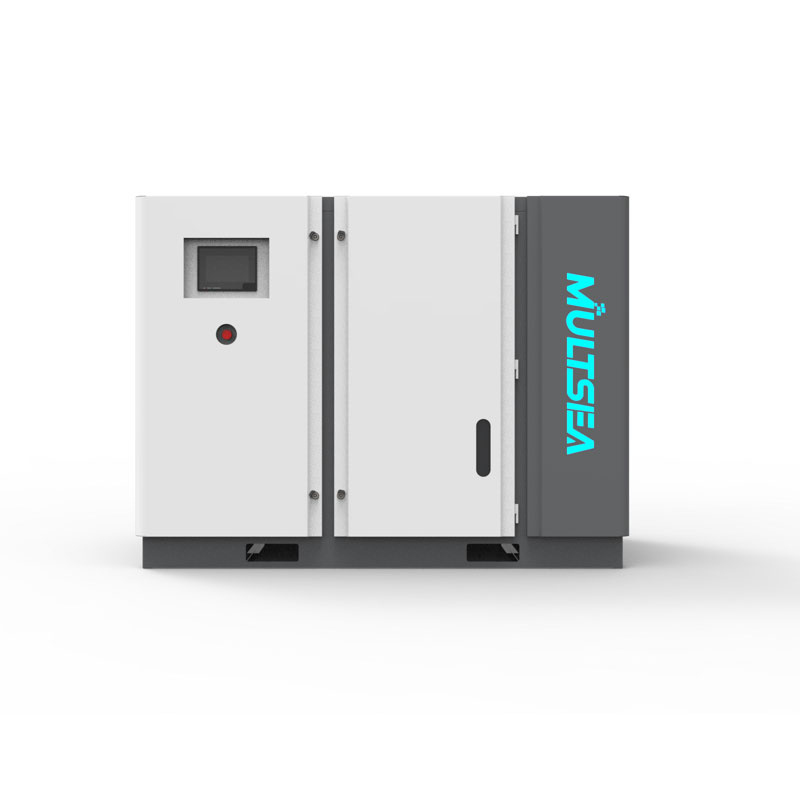
Industrial motor efficiency is governed by international standards. The most recent and stringent benchmark is the IE5 ultra-premium efficiency standard. Meeting this standard requires significant reductions in mechanical and electrical losses. Traditional induction motors struggle immensely to hit these benchmarks without becoming impractically large or expensive.
Permanent magnet designs consistently achieve these ultra-premium ratings. By eliminating rotor losses, an IE5 screw air compressor converts electrical power into mechanical power with minimal heat waste. You get more compressed air per kilowatt-hour than ever before.
Engineers push this efficiency even higher by modifying the compression process itself. This brings us to the role of two-stage compression. Instead of compressing air from atmospheric pressure to the final target pressure in a single step, the system divides the workload.
A two stage VFD screw compressor uses two separate rotary screw air-ends. The first stage compresses the air partially. The system then cools this intermediate air before feeding it into the second stage for final compression. This compounding approach delivers several distinct mechanical advantages:
Lower internal temperatures: Cooling the air between stages dramatically reduces the thermal stress on the oil and internal components.
Reduced internal leakage: Lower compression ratios per stage mean less air slips backward past the rotors.
Enhanced volumetric efficiency: The cooler, denser air yields more actual volume delivered to the factory floor.
Evaluating the cost-to-benefit reality requires a broad perspective. Dual-stage systems require a higher initial capital expenditure (CapEx) due to the secondary air-end and complex plumbing. However, the operational expenditure (OpEx) plummets. For manufacturing facilities running two or three continuous shifts, the aggressive energy reduction often creates a highly favorable payback period. The machine effectively pays for its own upgrade through lower monthly utility bills.
Motor & System Type | Motor Slip | Low RPM Efficiency | Lifecycle Energy Cost |
|---|---|---|---|
Standard Induction (Fixed Speed) | Yes (2-3%) | Poor (Unloaded Waste) | Highest |
Standard Induction (VFD) | Yes (2-3%) | Moderate Drop | Moderate |
Single-Stage PM (VFD) | None (Synchronous) | Excellent (Flat Curve) | Low |
Two-Stage PM (VFD) | None (Synchronous) | Ultra-Premium (IE5) | Lowest |
Selecting the right machinery heavily depends on understanding your specific factory environment. High-variance demand environments serve as the absolute ideal candidates for PM technology. Think of automotive assembly plants, dynamic packaging lines, or textile mills. These operations feature pneumatic tools and robotic arms that cycle on and off unpredictably.
A modern permanent magnet screw air compressor thrives in these chaotic load profiles. It scales its rotational speed up and down instantaneously to match demand spikes. It eliminates the wasteful "unloaded" running phases where standard compressors consume electricity without producing useful air.
Precision and clean manufacturing sectors also benefit immensely. In pharmaceuticals and food processing, maintaining perfectly stable pressure bands is critical for product quality. PM motors feature incredibly low inertia. They respond to pressure drops significantly faster than bulky induction motors. This rapid response holds the plant air pressure within a tight margin, ensuring sensitive downstream equipment functions flawlessly.
However, we must also recognize where this technology might be overkill. Building trust means acknowledging reality. Consider a facility with a perfectly flat, 100% continuous base load running 24/7 without any fluctuation. In this rare scenario, the compressor never needs to slow down. A standard, highly efficient fixed-speed compressor might offer a better initial return on investment here. If the machine never utilizes the variable speed capability, you are paying a premium for flexibility you do not need.
Automotive Manufacturing: Accommodates shifting loads from robotic painting and assembly lines seamlessly.
Food & Beverage Packaging: Provides rapid pressure stabilization for pneumatic filling and sealing machines.
Textile Production: Adjusts instantly to the rapid switching of air-jet looms across different operating shifts.
Electronics Assembly: Delivers precise, stable air flow required for delicate micro-component placement.
Procuring new capital equipment requires strict due diligence. Moving away from standard setups demands a clear financial and operational justification. You must view the compressor as a utility rather than a simple mechanical purchase.
Conduct a Data-Logged Air Audit: Never guess your air demand. We strongly recommend installing flow meters and power loggers on your current system for at least seven days. Map your actual peak demands, average loads, and minimum flows. Compare this precise data against the turndown capabilities of proposed PM machines.
Analyze CapEx versus OpEx: Frame your financial evaluation around a standard 10-year lifecycle. The initial purchase price (CapEx) feels significant, but it usually represents only 15% to 20% of the machine's lifetime cost. Energy consumption will account for roughly 75% of the total expense. The remaining percentage covers maintenance. Therefore, prioritizing electrical efficiency easily outweighs saving money on the initial sticker price.
Research Regional Utility Incentives: Utility providers often struggle to meet peak power demands. To alleviate grid stress, many offer substantial financial rebates to manufacturers who install ultra-efficient industrial equipment. Securing a rebate for deploying an IE5-rated variable speed system can drastically alter your shortlisting logic. It essentially subsidizes the cost of upgrading to premium technology.
Ensure Adequate Facility Environment: Assess the ambient conditions of your compressor room. PM systems require specific environmental controls, which leads directly to evaluating potential operational risks.
While the operational advantages are vast, adopting permanent magnet technology introduces specific engineering challenges. The most critical threat to these systems is thermal demagnetization. It is the elephant in the room that buyers must understand.
Rare-earth magnets rely on specific crystalline structures to maintain their powerful magnetic fields. If you expose these magnets to temperatures exceeding their thermal limits—typically above 120°C to 150°C, depending on the material grade—they can lose their magnetic properties permanently. Once a rotor demagnetizes, the motor fails. It cannot be repaired easily; the entire rotor or motor usually requires costly replacement.
To prevent this, you must carefully evaluate vendor cooling protocols. Scrutinize how the manufacturer controls the internal motor temperature. Some designs use an independent cooling fan, while others route the compressor's lubricating oil directly through a jacket surrounding the motor stator. Oil-cooled PM motors generally offer superior thermal stability. They keep the rare-earth magnets well below their danger zones, even during harsh, continuous operation in hot factory environments.
Maintenance shifts also require attention. The mechanical air-end—the rotors, bearings, and seals—demands similar maintenance to any traditional rotary screw machine. You still change filters, oil, and separators on a standard schedule. However, the electrical drive train is distinctly different.
The specialized inverter and PM motor require sophisticated diagnostic tools. Standard motor rewind shops cannot service them. If a stator burns out, you cannot simply drop it off at a local repair facility for a quick rewind. Reassembling a rotor loaded with immensely powerful rare-earth magnets requires factory-level tooling and safety protocols. Facility managers must guarantee that their chosen vendor provides robust, localized technical support and readily available spare parts.
A permanent magnet screw air compressor is not a magical fix for every industrial problem. However, it currently stands as the most mechanically sound and economically viable solution for drastically reducing utility expenses in variable-demand environments. By eliminating rotor slip and perfectly matching energy draw to air demand, these machines transform compressed air from a massive financial drain into a tightly controlled utility.
As you plan your next infrastructure upgrade, insist on hard data. Advise your procurement stakeholders to reject generic capacity quotes and standardized sales pitches. Require your equipment vendors to provide detailed energy simulations based strictly on your facility's logged demand profile. Taking these deliberate steps ensures your investment yields guaranteed efficiency, reliable performance, and a rapid, verifiable return on investment.
A: Yes. While standard induction VFD compressors lose motor efficiency at lower operating speeds, PM motors maintain a nearly flat, highly efficient performance curve across their entire speed range. This lack of rotor slip ensures maximum power conversion regardless of how much the compressor slows down.
A: The primary cause is excessive heat. This typically stems from poor compressor room ventilation, sustained operation beyond the machine's rated capacities, or a failure in the internal motor cooling system. Once temperatures cross a critical threshold, the magnets permanently lose their flux strength.
A: For manufacturing facilities operating two to three continuous shifts daily, yes. The substantial energy savings generated by dual-stage compression combined with permanent magnet efficiency usually offset the higher initial purchase price within 12 to 24 months of operation.
A: While technically possible in some scenarios, it is rarely recommended. The mechanical air-end, the variable frequency drive, and the PM motor must be engineered and precisely matched at the factory to prevent catastrophic control failures, erratic performance, and severe overheating.
