
P: +86-18866913099
E: sales01@latelas.com
E: sales01@latelas.com
NO 888 Maltsea Industrial Park, Mine Town, Lanling County, Linyi City, Shandong Province, China
Views: 0 Author: Site Editor Publish Time: 2026-06-02 Origin: Site


Choosing between a Fixed Speed Screw Air Compressor and a variable speed compressor is not simply about choosing the newer technology. The right choice depends on your air demand pattern, operating hours, energy cost, maintenance capability, and budget. A Fixed Speed Screw Air Compressor runs at a constant motor speed and is designed for stable, continuous compressed air demand. A variable speed compressor, also called a VSD or VFD compressor, adjusts motor speed according to real-time air consumption.
For many workshops, a Fixed Speed Screw Air Compressor remains a practical and cost-effective solution. It is suitable for production lines, pneumatic tools, spraying systems, packaging equipment, and other processes that need steady air supply. However, if your factory’s air demand changes sharply during the day, a variable speed compressor may reduce energy waste by matching output more closely to actual use.
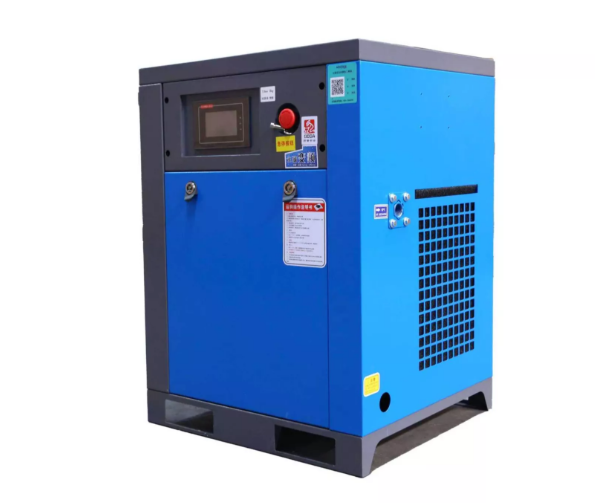
A Fixed Speed Screw Air Compressor is a rotary screw compressor that operates at one fixed motor speed. When it runs, the airend compresses air at a consistent speed. Instead of adjusting speed, the compressor controls pressure through loading and unloading. When system pressure drops, it loads and produces compressed air. When pressure reaches the upper set point, it unloads or stops depending on the control design.
The main advantage of a Fixed Speed Screw Air Compressor is simplicity. It usually has a lower initial cost, a straightforward structure, and easier routine maintenance than a variable speed model. A Fixed-Speed Electric Stationary Screw Compressor is commonly installed in factories where compressed air demand is stable and predictable.
A variable speed compressor uses a drive system to change motor speed based on compressed air demand. When demand rises, the compressor speeds up. When demand falls, it slows down. This helps reduce wasted electricity in facilities where air consumption changes frequently.
Variable speed compressors are often chosen for plants with multiple production lines, different shift loads, or processes that start and stop often. They can provide tighter pressure control and lower starting current. However, they also cost more upfront and include more complex electronic controls.
Comparison Point | Fixed Speed Screw Air Compressor | Variable Speed Compressor |
Motor operation | Runs at constant speed | Adjusts speed to demand |
Best for | Stable and continuous air use | Fluctuating air demand |
Initial cost | Usually lower | Usually higher |
Maintenance | Simpler and easier to service | More technical due to inverter controls |
Energy performance | Efficient when demand is steady | Better when demand changes often |
Pressure control | Stable with correct sizing and storage | Tighter pressure control |
Startup behavior | Higher starting current, depending on design | Softer start and lower current impact |
Typical use | Pneumatic tools, packaging, spraying, production lines | Multi-shift plants and variable-load systems |
The central difference is clear: a Fixed Speed Screw Air Compressor is strongest when demand is steady, while a variable speed compressor is stronger when demand changes throughout the day.
A Fixed Speed Screw Air Compressor uses two rotors to compress air. The motor drives the screw airend at a fixed speed, and compressed air is delivered through the oil separation, cooling, and control process. Because motor speed does not change, the compressor performs best when actual air demand is close to rated output.
Correct sizing is critical. If the Fixed Speed Screw Air Compressor is too large, it may unload too often and waste energy. If it is too small, it may run continuously but still fail to maintain pressure during peak use. Buyers should check working pressure, air flow, duty cycle, number of air-using tools, future expansion, and air receiver capacity before selection.
A Fixed Speed Screw Air Compressor is usually the better choice when compressed air demand is stable, predictable, and continuous. It is well suited for factories that do not need frequent output adjustment but require reliable air supply every day.
You should consider a Fixed Speed Screw Air Compressor if:
● Your air demand stays stable for most of the working day.
● Your production line uses similar equipment at similar capacity.
● Your priority is lower purchase cost.
● Your maintenance team prefers simpler systems.
● Your process does not require extremely tight pressure control.
● Your compressed air system includes a properly sized air receiver.
● You want a practical compressor for small or medium industrial production.
Common applications include furniture manufacturing, hardware production, packaging, textile production, electronics assembly, plastic processing, auto repair, and spraying workshops. In these situations, a Fixed Speed Screw Air Compressor can offer dependable performance without unnecessary investment in variable-frequency technology.
A variable speed compressor is usually better when compressed air demand changes significantly. If your plant has machines that start and stop at different times, or if air demand changes between shifts, variable speed control may reduce wasted electricity.
You should consider a variable speed compressor if:
● Air demand rises and falls frequently.
● Your plant often operates below full compressor capacity.
● Electricity cost is a major operating concern.
● You need tighter pressure control.
● Your facility has different production loads by shift.
● Your team can maintain inverter-driven equipment.
Variable speed compressors are common in large factories, multi-process plants, electronics manufacturing, automotive production, and food packaging. Still, if air demand is steady, the energy savings may not justify the higher purchase price.
Energy cost is often the biggest factor when comparing a Fixed Speed Screw Air Compressor with a variable speed compressor. But energy savings depend on the demand profile, not only the compressor type.
If a factory uses compressed air continuously at a stable level, a Fixed Speed Screw Air Compressor can operate efficiently because its output is close to actual demand. If demand changes sharply, the same fixed-speed machine may load and unload frequently, consuming electricity without always producing useful compressed air.
Air Demand Pattern | Better Choice | Reason |
Stable demand for long hours | Fixed Speed Screw Air Compressor | Lower cost and strong full-load operation |
Demand changes by shift | Variable speed compressor | Adjusts output during low-demand periods |
One constant production line | Fixed Speed Screw Air Compressor | Simple and reliable for base load |
Multiple machines start and stop often | Variable speed compressor | Reduces unloaded energy waste |
Large plant with base load and peaks | Mixed system | Fixed speed handles base load; VSD handles fluctuation |
Budget-sensitive factory | Fixed Speed Screw Air Compressor | Lower initial investment and simpler service |
Total cost of ownership should include purchase price, electricity cost, installation, maintenance, spare parts, downtime risk, air treatment, pressure stability, and service life. A Fixed Speed Screw Air Compressor often wins on initial investment and maintenance simplicity. A variable speed compressor may win when electricity prices are high and demand fluctuates enough to create real savings.
A Fixed Speed Screw Air Compressor usually has a simpler control structure than a variable speed compressor. It does not rely on a variable-frequency drive to change motor speed, so routine service is easier for many factories.
Typical maintenance includes checking lubricating oil, replacing air filters, replacing oil filters, checking the oil-air separator, cleaning coolers, draining condensate, and inspecting pressure settings. A variable speed compressor needs similar basic maintenance, but it also requires attention to inverter cooling, electronic control protection, voltage stability, and dust prevention.
For factories that value simple operation and easy service, a Fixed Speed Screw Air Compressor may be more suitable.
Compressed air pressure affects production quality. Low pressure can reduce pneumatic tool power, affect spraying quality, and cause automation equipment to slow down. A Fixed Speed Screw Air Compressor can provide stable pressure when properly sized and supported by enough air storage. A variable speed compressor can provide tighter pressure control when demand fluctuates.
However, pressure stability is not only decided by compressor type. It also depends on air receiver size, pipe diameter, filter pressure drop, dryer condition, leakage rate, control settings, and distance from the compressor to the air-using equipment.
A Combined Screw Air Compressor integrates several compressed air functions into one compact unit. Depending on the design, it may combine the compressor, air tank, dryer, filtration, and control system. This is useful for workshops that want simpler installation and a smaller footprint.
A Combined Screw Air Compressor can reduce the need to purchase and connect separate components. It is often suitable for small and medium-sized factories, auto repair shops, laser processing, precision production, and packaging applications. However, buyers should still confirm pressure, air flow, air quality, and duty cycle before purchase.
Many facilities do not need to choose only one technology. A practical system may use a Fixed Speed Screw Air Compressor as the base-load machine and a variable speed compressor for fluctuating demand.
In this setup, the Fixed Speed Screw Air Compressor handles the stable air demand that exists most of the time. The variable speed unit responds to peaks and low-demand periods. For example, if a factory always needs 60% of its compressed air capacity during production, a Fixed Speed Screw Air Compressor can handle that base demand. When extra machines start, the variable speed compressor adds output.
Avoid these mistakes when comparing compressor types:
● Buying only by price instead of total cost of ownership.
● Assuming variable speed is always better.
● Oversizing the Fixed Speed Screw Air Compressor.
● Ignoring air leaks before upgrading equipment.
● Using a small air receiver in a system with unstable demand.
● Forgetting air quality requirements for spraying, food packaging, electronics, or precision equipment.
● Choosing motor power before confirming actual air flow and pressure.
The main difference between a Fixed Speed Screw Air Compressor and a variable speed compressor is how they respond to air demand. A Fixed Speed Screw Air Compressor runs at constant speed and is ideal for stable, continuous, predictable air use. It offers lower initial cost, simpler maintenance, and dependable operation.
A variable speed compressor adjusts motor speed according to demand. It is better for plants with changing air consumption, high electricity costs, and tighter pressure requirements. But it also requires higher investment and more technical maintenance.
For workshops with stable production, pneumatic tools, packaging lines, spraying equipment, and general industrial use, a Fixed Speed Screw Air Compressor remains a cost-effective choice. For larger plants with changing demand, a variable speed compressor or a mixed system may deliver better long-term savings.
A: Yes. A Fixed Speed Screw Air Compressor can support continuous operation when air demand is stable and the machine is correctly sized. Regular oil, filter, cooler, and condensate maintenance is still necessary.
A: Yes. It can be connected with an air dryer, filters, air tank, and drainage system to improve air quality for spraying, packaging, electronics, and other applications.
A: No. It saves more energy when demand changes often. If demand is stable, a Fixed Speed Screw Air Compressor may offer better value because of lower purchase and maintenance costs.
A: A Combined Screw Air Compressor can integrate compression, air storage, drying, and filtration in one compact system, making installation easier for small and medium-sized workshops.
A: Repair leaks, avoid excessive discharge pressure, clean filters, use a suitable air receiver, maintain the cooling system, and select a compressor capacity that matches actual demand.
